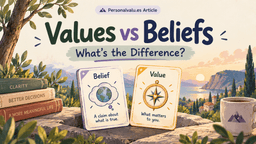
Values vs Beliefs: What's the Difference? (With Examples)
Updated
A belief is something you hold to be true. A value is something you hold to be important. "Hard work pays off" is a belief, because it is a claim about how the world works and it could turn out to be wrong. Discipline is a value, because it names something you care about, and it cannot be true or false. Beliefs shape how you see the world, while values shape what matters to you and how you choose to act.
| Belief | Value | |
|---|---|---|
| The question it answers | What is true? | What matters to me? |
| Can it be true or false? | Yes | No |
| How many you hold | Many, often thousands | A smaller set of broad priorities |
| How you hold it | With more or less certainty | In an order, some above others |
| What influences change? | New evidence, experiences and reflection | Life experiences, reflection and changing priorities |
| Example | "People can change." | Growth |
Beliefs and values are easy to mix up because they usually travel together. Many values rest on beliefs, and the values you hold make some beliefs easier to accept than others. This article explains each one, the five differences between them, how they shape each other, and how to tell which is which. For how both relate to principles, virtues, morals and ethics, read Ethics, morality, principles, values, virtues and beliefs.
What is a belief?
A belief is an idea you accept as true. It can be about yourself ("I'm good with people"), about others ("Most people mean well"), about the world ("The economy rewards risk-takers") or about things no one can check ("There is life after death").
You hold far more beliefs than you are aware of. Most of them you never chose. They came from your family, your school, your culture and your own experience, and they work in the background like a lens. Two people can watch the same event and come away with different conclusions because they look at it through different beliefs.
What makes something a belief is that it is a claim. It says something is the case, so in principle it can be right or wrong, even when no one can settle it.
What is a value?
A value is something you hold to be important, a quality or an outcome you want in your life. Family, health, honesty, freedom and financial stability are values. Each of them is a standard you use, often without noticing, to choose between options and to judge how your life is going.
Psychologist Shalom Schwartz developed one of the most influential theories of basic human values, describing values as desirable goals that transcend specific situations. You value honesty at work, at home and with strangers. Values also come in an order. Most people value both adventure and security, and which of the two ranks higher is what decides their choices.
More on what values are and where they come from in What are core values and why are they important?
The key differences between values and beliefs
In everyday language, the distinction is straightforward, but psychology uses the terms in more than one way. Some theories distinguish values from beliefs, while others describe values as a particular kind of belief. The five differences below follow the everyday meaning. The technical one is covered further down, in Are values a type of belief?
1. Beliefs are about what is true, values are about what matters
This is the core difference. A belief describes ("Exercise lowers stress"). A value prefers ("Health matters to me"). Philosophers have long distinguished between descriptive statements and normative judgments. David Hume famously argued that conclusions about what ought to be cannot follow from descriptions of what is without an additional normative premise. In everyday decisions, values often provide that missing premise.
2. Beliefs can be tested against evidence; values are evaluated differently
You can test many beliefs against evidence. If you believe your city is dangerous, crime figures can support or challenge that belief, although the interpretation may depend on which crimes and time periods you consider. No set of statistics can establish that security should matter more to you than excitement. You can examine the consequences of your priorities and ask whether they fit the life you want, but that is different from proving a value true or false.
This is also why arguments about beliefs and arguments about values can feel different. A disagreement about factual claims may be resolved by new evidence. A disagreement about priorities often requires people to understand what each side considers important.
3. Beliefs are many and specific, values are fewer and broader
Milton Rokeach was an influential researcher who studied the relationships between beliefs, attitudes and values. His Rokeach Value Survey included 36 values: 18 terminal values, representing desired end states, and 18 instrumental values, representing preferred modes of conduct. The list on personalvalu.es includes 62 values, and the assessment asks users to rank ten of them. Ten is the assessment's format, not a rule about how many values a person has.
Beliefs can concern almost anything, from what you will eat tomorrow to how the universe began. Values are fewer because they are broader. One value, such as justice, can support many beliefs about how courts, schools or workplaces should run.
4. Beliefs are held with certainty, values in an order
You hold a belief with more or less confidence. You might be sure the sun will rise tomorrow and only half sure your team will win the league. Values work differently. You rarely doubt that a value matters to you. What you weigh is how much it matters compared with your other values.
That order is what makes values useful in practice. When honesty and loyalty pull in opposite directions, the belief "both are good" does not help you decide. Knowing which one ranks higher does. More in What happens when your values conflict.
5. Beliefs change with evidence, values change with life
A belief can change in an afternoon. One conversation, one article or one bad experience can be enough. Values tend to change more slowly, and more often through life events than through arguments. Becoming a parent, losing a job or falling ill can move family, job security or health up your list, while years of debate rarely do. More in Can my core values change over time?
Values vs beliefs examples
Each belief below can support a value. The belief is the claim, the value is what the claim can make important.
| Belief | Value it can support |
|---|---|
| "People can change." | Growth, forgiveness |
| "Life is short." | Adventure, pleasure |
| "The world is unpredictable." | Security, financial stability |
| "Everyone deserves a fair chance." | Justice, equality |
| "Lies always come out in the end." | Honesty |
| "Hard work pays off." | Discipline, ambition |
| "We are stronger together." | Teamwork, loyalty |
| "God exists." | Religion, spirituality |
| "Without health, nothing else works." | Health |
| "No one else can decide what is right for me." | Freedom, independence |
The link is not fixed, though. A belief can support a value without requiring it. The same belief can lead two people to different values, and the same value can rest on different beliefs.
- One belief, different values. "Life is short" leads one person to adventure, and another to family, because time with the people they love feels like the best use of it.
- One value, different beliefs. Two people can both put security first. One because they believe the world is dangerous, the other because they grew up without it and believe stability is what lets everything else grow.
This is why you cannot reliably read someone's values from their beliefs, or the other way around. You have to ask what they hold important.
How beliefs and values shape each other
Beliefs can help shape values from an early age. A child who learns "people who love you keep their promises" may grow into an adult who values commitment. But the relationship works both ways, and there is no universal order in which beliefs and values develop.
Values shape beliefs too. Psychologists call one version of this motivated reasoning: people find it easier to accept claims that support conclusions they want to reach, and look harder for flaws in claims that threaten them (Kunda, 1990). Someone who values tradition may find arguments for keeping old institutions more convincing than someone who values variety. Knowing your values helps you notice when they, rather than the evidence, are doing the persuading.
When a belief changes, the values built on it can wobble. If you stop believing hard work pays off, ambition may lose its pull, or it may find a new belief to rest on. A value that survives a change of belief is often one you hold deeply.
Are values a type of belief?
In some psychological theories, yes. Rokeach defined a value as "an enduring belief that a specific mode of conduct or end-state of existence is personally or socially preferable" to its opposite. He sorted beliefs into three kinds: those about what is true or false, those about what is good or bad, and those about what is desirable. Values belong to the third kind. Schwartz also describes values as beliefs, but beliefs tied to feeling, which is why a threat to your values can make you angry or anxious rather than just curious.
In everyday language, the line is simpler. When people say "belief", they mean a claim about what is true. When they say "value", they mean what they hold important. This article uses the everyday meaning, because that is the difference most people are asking about.
Core values vs core beliefs
The two phrases come from different places. Core beliefs is a term from cognitive behavioral therapy (CBT). It means the deepest beliefs a person holds about themselves, other people and the world, often formed in childhood, such as "I'm not good enough" or "People can't be trusted". In her widely used CBT textbook, the psychologist Judith Beck groups negative core beliefs about the self into three broad categories: helpless, unlovable and worthless. Much of CBT is about noticing these beliefs and testing them against evidence.
Core values are the handful of values that matter most to you, such as love, creativity or respect. They are not tested against evidence in the same way factual beliefs are. They are clarified, prioritized and expressed through action. Acceptance and Commitment Therapy (ACT), another widely studied therapy, works with them directly, helping people clarify what they care about and act on it even while painful beliefs and feelings are still present.
The two meet in everyday life. A core belief such as "I'm not good enough" can keep you from a core value such as growth, because trying something new feels too risky. Naming both helps. The belief can be questioned, and the value can be acted on in small steps.
Values, beliefs, attitudes and morals
Two more words often appear next to values and beliefs.
- An attitude is how much you like or dislike something specific, such as a political party, a brand or remote work. Attitudes are many and narrow. Values are few and broad, and they explain many attitudes at once.
- Morals are your sense of right and wrong. They draw on some of your values, such as honesty or justice, and on beliefs about what people owe each other. Many values are not moral at all. Valuing beauty or adventure says nothing about right and wrong.
| Answers | Example | |
|---|---|---|
| Belief | What is true? | "Exercise lowers stress." |
| Value | What matters? | Health |
| Attitude | What do I like? | "I enjoy running." |
| Moral | What is right? | "It is wrong to lie to a friend." |
The full comparison, with principles, virtues and ethics, is in Ethics, morality, principles, values, virtues and beliefs: what's the difference?
How to tell whether something is a value or a belief
Ask three questions.
- Could it be wrong? If evidence could in principle prove it wrong, it is a belief. "Money brings happiness" could be tested. Wealth as something you want cannot.
- Does it fit "… matters to me"? "Honesty matters to me" works. "The earth is round matters to me" does not. Values fit the sentence, beliefs fit "I think that…".
- Does it hold across situations? A value guides you at work, at home and with strangers. A belief is often about one area of life.
Many statements mix both. "Family comes first" is a value phrased as a belief. Underneath it is family, and probably a belief such as "Family is the only thing that lasts".
How to find your values
Your beliefs show up in what you say. Your values show up in what you choose, so they are harder to see from the inside.
- Look at real moments. Recall a time you felt proud or fully yourself, and a time you felt angry or ashamed. Ask which value was honored in the first and which was at stake in the second.
- Choose from a list. Go through the core values list and pick the ten that feel most like you. A list helps you name values you would not think of on your own.
- Put them in order. Compare your values two at a time and ask which matters more. You can rank your values on personalvalu.es for free in about ten minutes, the same way nearly 2.1 million rankings have been made since 2020.
Then look at your top values next to the beliefs you hold most strongly. Where a belief supports a value, it is worth keeping. Where a belief keeps you from a value, it is worth questioning.
Further research
- Beck, J. S. (2011). Cognitive Behavior Therapy: Basics and Beyond (2nd ed.). Guilford Press.
- Hume, D. (1739–1740). A Treatise of Human Nature, Book III, Part I, Section I.
- Kunda, Z. (1990). The case for motivated reasoning. Psychological Bulletin, 108(3), 480–498.
- Rokeach, M. (1968). Beliefs, Attitudes, and Values: A Theory of Organization and Change. Jossey-Bass.
- Rokeach, M. (1973). The Nature of Human Values. Free Press.
- Schwartz, S. H. (2012). An overview of the Schwartz theory of basic values. Online Readings in Psychology and Culture, 2(1).
Frequently asked questions about values and beliefs
What is the difference between values and beliefs?
A belief is something you hold to be true, such as "people can change". A value is something you hold to be important, such as growth. Many beliefs can be checked against evidence. Values are not true or false in that way. They are ranked by how much they matter to you.
Are beliefs and values the same?
No. They are closely linked, because values often rest on beliefs, but they answer different questions. Beliefs answer "what is true?", values answer "what matters?". In psychology, values are sometimes described as a special kind of belief, one about what is desirable rather than what is true.
Which comes first, beliefs or values?
Neither, as a rule. They influence each other, and the order depends on the person and the context. A belief such as "life is short" can make adventure matter more, and once you hold a value, you find it easier to accept beliefs that support it.
What are some examples of values and beliefs?
"Hard work pays off" is a belief that can support the value of discipline. "Everyone deserves a fair chance" can support justice. "The world is unpredictable" can support security. In each pair, the belief is a claim and the value is what the claim can make important.
What is the difference between core values and core beliefs?
Core beliefs are a term from cognitive behavioral therapy for the deepest beliefs you hold about yourself, others and the world, such as "I'm not good enough". Core values are the few values that matter most to you, such as family or honesty. Core beliefs can be examined against evidence and changed, while core values are clarified, prioritized and acted on.
Can a value be wrong?
A value cannot be wrong in the way a factual belief can, because it does not claim that something is true. It can still be judged in other ways, such as whether it helps you, whether it is ethical and whether it fits your other commitments. A value you put first can leave too little room for others you care about, and a value you took over from someone else may not fit your life. That is why it helps to rank your values rather than just list them.
Can beliefs change your values?
Yes. When a belief behind a value changes, the value can lose its pull or find a new reason to stay. Values tend to change more slowly than beliefs, and more often through life events than through arguments.
How do I find out what my values are?
Recall moments when you felt most like yourself and moments that made you angry, and ask which value was involved. Then choose about ten values from a list and put them in order by comparing two at a time. You can rank your values on personalvalu.es for free in about ten minutes.