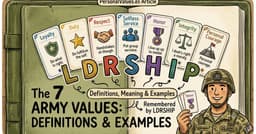
What Are the 7 Army Values? (Definitions, Meaning & Examples)
Updated
The Army Values are the seven core values that every US Army soldier is expected to live by: Loyalty, Duty, Respect, Selfless Service, Honor, Integrity, and Personal Courage. They are remembered with the acronym LDRSHIP, and they are not a motivational slogan - they are the official standard of conduct the US Army trains, evaluates, and leads by, set out in the Army's leadership doctrine.
Soldiers learn the 7 Army Values in Basic Combat Training and carry them on a card in their wallet and a tag on their dog tags. Below you will find each of the army values and definitions in the Army's own terms, what each one looks like in practice, and why the army's core values have become one of the most widely borrowed values frameworks outside the military.
The 7 Army Values Explained (LDRSHIP)
The seven values are always listed in the same order, because that order spells LDRSHIP - the Army's built-in memory aid. Each value has an official one-line definition, and the Army deliberately keeps them short so that a soldier can recall them under pressure.
| # | Army Value | Definition (in short) |
|---|---|---|
| L | Loyalty | Bear true faith and allegiance to the US Constitution, the Army, your unit, and other soldiers. |
| D | Duty | Fulfill your obligations - do your job to standard, every time. |
| R | Respect | Treat people as they should be treated. |
| S | Selfless Service | Put the welfare of the nation, the Army, and your subordinates before your own. |
| H | Honor | Live up to all the Army Values. |
| I | Integrity | Do what is right, legally and morally. |
| P | Personal Courage | Face fear, danger, or adversity - both physical and moral. |
Two things stand out immediately about this list. First, Honor is not a separate virtue so much as a container - the Army defines it as living up to the other six. Second, Personal Courage is explicitly moral as well as physical, which is the Army's way of saying that speaking up in a meeting can require as much courage as advancing under fire.
The rest of this article takes each of the seven values in turn.
1. Loyalty
Official definition: bear true faith and allegiance to the US Constitution, the Army, your unit, and other soldiers.
Loyalty in the Army runs in a specific order, and that order matters. A soldier's first allegiance is to the Constitution - not to a person, a commander, or even the Army as an institution. Only after that come the Army, the unit, and fellow soldiers. This hierarchy is deliberate. It is what makes loyalty a value rather than mere obedience.
In practice, loyalty means bearing your share of the unit's work without complaint, supporting a decision once it has been made even if you argued against it, and refusing to let a fellow soldier fail alone. The Army is careful to distinguish loyalty from blind allegiance: covering for a comrade's misconduct is not loyalty, it is a betrayal of the higher loyalties the value names.
Example: a squad leader disagrees strongly with a plan during the planning phase and says so directly. Once the commander decides, the squad leader executes the plan fully and publicly backs it - while continuing to raise concerns through the proper channels.
Why it matters for leadership: loyalty is what allows a team to argue hard and still act as one. Leaders earn upward loyalty by demonstrating downward loyalty first - protecting their people, sharing hardship, and taking responsibility for failures rather than distributing blame.
2. Duty
Official definition: fulfill your obligations.
Duty is the value that turns intention into reliable action. It means doing your job to the required standard - not to the minimum acceptable level, and not only when someone is watching. The Army draws a sharp line between duty and mere compliance: compliance stops when the task is technically complete, while duty asks whether the job was actually done right.
In practice, duty means completing maintenance properly when nobody will inspect it, telling a superior that a task is behind schedule rather than hiding it, and taking on the work that needs doing even when it falls outside your job description. It also includes the harder edge of the value: refusing an order that is illegal or immoral, because a soldier's duty runs to the law and the mission, not to any individual.
Example: a mechanic finds a fault on a vehicle that has already passed inspection and is due to roll out in an hour. Duty means reporting it, accepting the delay, and fixing it - even though staying silent would be easier and probably unnoticed.
Why it matters for leadership: an organisation cannot plan around people who only sometimes deliver. Duty is what makes trust computable - it is the value that lets a commander build a plan on the assumption that each part will hold.
3. Respect
Official definition: treat people as they should be treated.
Respect is the Army's version of the golden rule, and it is grounded in a specific claim: that the strength of the Army comes from its people, and that people perform when their dignity is intact. Respect is owed both upward and downward - it is not a courtesy that flows only towards rank.
In practice, respect means listening to a subordinate's assessment before overriding it, refusing to tolerate harassment or discrimination in a unit, giving credit where it is earned, and treating civilians, prisoners, and local populations with the dignity the law and the Army's ethics require. It also means self-respect: holding yourself to the same standard you enforce in others.
Example: a young lieutenant, technically outranking a sergeant with twenty years of experience, asks for that sergeant's read on a situation before issuing an order - and says so openly in front of the platoon.
Why it matters for leadership: respect is the precondition for honest information. A team that does not feel respected filters what it tells its leader, and a leader who is being filtered is effectively blind.
4. Selfless Service
Official definition: put the welfare of the nation, the Army, and your subordinates before your own.
Selfless Service is the value most people associate with the military, and it is the one most easily sentimentalised. The Army's framing is unromantic: it is about the mission over the individual, not about martyrdom. It does not mean neglecting yourself or your family - it means that when the interests genuinely conflict, the larger good takes precedence.
In practice, selfless service means the platoon leader who eats last, the soldier who volunteers for the unglamorous detail, and the officer who accepts an assignment that is good for the Army and bad for their own career progression. It is deliberately contrasted with careerism - advancing yourself at the expense of your unit.
Example: a company commander who could take credit for a successful operation instead names the junior soldiers whose initiative made it work, knowing the recognition will help their careers more than it would help hers.
Why it matters for leadership: a leader who visibly puts the unit first can ask for sacrifice and be believed. One who does not, cannot - and no amount of authority will substitute for that.
5. Honor
Official definition: live up to all the Army Values.
Honor is the keystone of the LDRSHIP acronym, and it is defined recursively on purpose. It is not a distinct behaviour so much as the consistent, public demonstration of the other six values - the reputation you earn by living them when it is inconvenient.
In practice, honor is what makes the other values non-negotiable rather than situational. A soldier of honor does not treat integrity as something to be traded for advantage or courage as something to be summoned only when observed. The Army ties honor directly to the Medal of Honor tradition: the nation's highest recognition is not called the Medal of Courage or the Medal of Duty, because honor is understood to encompass all of it.
Example: a soldier who consistently reports their own mistakes, keeps their word to subordinates when it costs them, and holds the line on standards even when their peers do not - and is known for it.
Why it matters for leadership: honor is the only part of a leader's authority that cannot be issued by an order. Rank is granted; honor is earned and can be lost in a single decision.
6. Integrity
Official definition: do what is right, legally and morally.
Integrity means that your actions match your stated principles - including when no one is checking. The Army defines it as a matter of consistency: honest people are known for it, and that reputation is built by repeatedly choosing the harder right over the easier wrong.
Critically, the Army's definition includes both the legal and the moral dimension. Something can be technically permissible and still wrong, and integrity is the value that closes that gap.
In practice, integrity means accurate reporting even when the numbers are embarrassing, refusing to shade the truth to make a unit look better, admitting to a mistake before it is discovered, and declining to exploit a rule you know is being applied unfairly.
Example: an NCO discovers that inflating a training completion figure would keep the unit's statistics clean and hurt no one directly. Integrity means reporting the real number, accepting the scrutiny, and fixing the underlying gap.
Why it matters for leadership: integrity is the substrate of every other value. Once a leader is known to shade the truth, every report they make and every promise they give is discounted - and the discount is permanent.
7. Personal Courage
Official definition: face fear, danger, or adversity (physical or moral).
The Army's definition of Personal Courage is deliberately two-sided. Physical courage is what most people picture: continuing to act under fire, in danger, or under extreme physical hardship. Moral courage is the willingness to stand up for and act on what you believe is right - to report misconduct, to tell a superior something they do not want to hear, to be the only person in the room who objects.
The Army is explicit that courage is not the absence of fear. It is the decision to act despite it, and it can be built - through training, preparation, and repeatedly making the hard call in small things.
In practice, moral courage is the harder and more common test. Physical courage is demanded rarely and in extremis; moral courage is demanded weekly, in rooms where the social cost of speaking is immediate and the cost of silence is deferred.
Example: a specialist witnesses a superior mistreating a subordinate and reports it, knowing it will make life uncomfortable and that staying quiet would cost nothing in the short term.
Why it matters for leadership: an organisation only learns what it is willing to hear. Moral courage in subordinates is what surfaces the problems a leader needs to know about - and a leader's own moral courage is what makes that safe.
Army Values and Leadership
The connection between the Army Values and Army leadership doctrine is not incidental - it is structural. The acronym itself spells LDRSHIP, and the Army's capstone leadership publication, ADP 6-22, Army Leadership and the Profession (July 2019), puts the seven values at the foundation of what a leader is, before anything a leader knows or does. Its companion field manual, FM 6-22, Developing Leaders (2022), covers how those leaders are then grown.
Army doctrine describes leadership through the Be-Know-Do framework, introduced in the 1999 edition of FM 22-100 and still the Army's shorthand for how character, competence, and action fit together:
- Be - character. This is where the seven Army Values live. Who the leader is when the pressure is on.
- Know - competence. Tactical, technical, interpersonal, and conceptual skill.
- Do - action. Influencing, operating, and improving the organisation.
Current doctrine expresses this as the Army Leadership Requirements Model: leader attributes - character, presence, and intellect - are the "be" and "know", while leader competencies - leads, develops, achieves - are the "do". The Army Values sit inside the first attribute, character, which is the doctrinal way of saying they come before everything else.
The order is the argument. Competence without character produces a leader who is effective and untrustworthy - which, in an institution that hands people lethal authority, is a catastrophic failure mode. This is why the Army treats values as a trained capability rather than a personality trait: they are taught, modelled, evaluated in performance reviews, and reinforced through the Army Ethic.
The doctrine also frames leadership as influencing people by providing purpose, direction, and motivation. Every one of those three depends on values: purpose is grounded in selfless service and duty, direction depends on integrity and honest information, and motivation collapses without respect and demonstrated loyalty. Take the values out and Army leadership becomes bare command - which works exactly until conditions get hard, and then stops.
This is also why the framework has been adopted far outside the military. The Army solved a problem most organisations still struggle with: it made abstract virtues operational - short enough to memorise, concrete enough to evaluate, and explicitly tied to how leaders are selected and promoted. That is a large part of why anyone researching values-based leadership ends up looking at LDRSHIP.
How the Army Values Compare to Other Core Value Systems
The Army Values are a prescribed value system. They are handed to you, they are the same for every soldier, and their function is to align a very large organisation around a single standard of conduct. That is exactly what an institution that operates under lethal pressure needs.
Personal values work the other way around. They are discovered, not assigned. Their job is not to make you interchangeable with your peers - it is to describe what actually drives you: what you need from work, from relationships, and from a life to feel that it was well spent. A soldier can hold Loyalty, Duty, and Personal Courage as institutional obligations while their personal top values turn out to be freedom, curiosity, and family. Neither list invalidates the other.
The Personal Values Assessment at personalvalu.es is built for that second question. Instead of seven prescribed values it uses a deck of 62 values - you can browse the full core values list - and it does not ask you to rate them. It makes you choose between them, two at a time, until a ranked order emerges. That forced trade-off is the point: in the abstract, everyone endorses loyalty and courage and integrity. You only learn what you actually prioritise when you are made to give one up.
Underneath the 62 values sit five fundamental human needs - Stability, Connection, Autonomy, Development, and Impact - and the Army Values map onto them recognisably. Loyalty and Selfless Service are Connection and Impact values. Duty, Integrity, and Honor cluster around Stability and Impact - reliability and standing for something. Personal Courage is what it costs to defend any of them. Seeing that mapping is often what makes the framework click for people arriving from a military background: LDRSHIP is not a different species of value, it is a specific, institutionally-chosen selection from the same human material.
How do the Army Values fare when civilians choose freely? The Global Values Research counts how often each of the 62 values appears in a person's ten, across nearly 2.1 million rankings completed on personalvalu.es since 2020. Matching each Army Value to its closest value in the deck:
| Army Value | Closest personal value | Share of rankings | Rank of 62 |
|---|---|---|---|
| Respect | Respect | 30.0% | 7th |
| Loyalty | Loyalty | 22.4% | 13th |
| Integrity | Honesty | 21.2% | 14th |
| Duty | Accountability | 17.1% | 24th |
| Honor | Ethics | 15.5% | 26th |
| Selfless Service | Helpfulness | 14.8% | 28th |
| Personal Courage | Courage | 11.0% | 42nd |
Respect, loyalty and honesty are values most people already hold. Courage is the outlier, chosen by only about one person in nine. That fits the Army's own framing of courage as the value that costs something in the moment, and it is a good argument for why an institution has to name it explicitly rather than assume it.
If you want to go deeper on the underlying distinctions - values versus principles versus virtues versus ethics - the differences are worth understanding, since "honor" is a virtue, "do what is right" is a principle, and the Army treats both as values. See the difference between beliefs, values, principles, virtues, morality and ethics. And if you are leaving the service and trying to work out which parts of the military framework are yours and which were the uniform's, how to live aligned to your core values and what are my work values are the natural next steps.
Conclusion
The 7 Army Values - Loyalty, Duty, Respect, Selfless Service, Honor, Integrity, Personal Courage - have endured because they are short enough to remember under pressure and demanding enough to actually cost something. That is a rare combination, and it is why LDRSHIP is studied far beyond the ranks of the US Army.
But a prescribed values system, however good, answers only half the question. It tells you what an institution requires of you. It does not tell you what you require of a life. If the Army Values brought you here, the natural companion question is which values are genuinely your own - and that one you have to answer for yourself.
Frequently asked questions about the Army Values
What are the 7 Army Values?
The 7 Army Values are Loyalty, Duty, Respect, Selfless Service, Honor, Integrity, and Personal Courage. They are the official core values of the US Army, taught to every soldier in Basic Combat Training and set out in Army leadership doctrine. They are always listed in that order because the first letters spell the acronym LDRSHIP.
What does LDRSHIP stand for?
LDRSHIP is the memory aid for the seven army core values: Loyalty, Duty, Respect, Selfless Service, Honor, Integrity, and Personal Courage. The ordering is deliberate - the letters echo the word "leadership", reflecting the Army's position that character is the foundation of leadership rather than an accessory to it.
Why are army values important?
Because the Army entrusts people with lethal authority under extreme pressure, and rules alone cannot cover every situation they will face. The army values give soldiers a shared standard of conduct that holds when supervision, communication, and clear orders break down. They are also the basis of trust inside a unit - soldiers must be able to assume that the person next to them will do their duty, tell the truth, and not abandon them. Beyond the military, the same framework is widely used because it turns abstract virtues into something memorable, teachable, and evaluable.
What is the difference between army values and military values?
Army values refers specifically to the seven values of the US Army (LDRSHIP). Military values is the broader term covering the core values of all branches, which differ in wording and number:
- Army - Loyalty, Duty, Respect, Selfless Service, Honor, Integrity, Personal Courage (LDRSHIP).
- Navy and Marine Corps - Honor, Courage, Commitment.
- Air Force - Integrity First, Service Before Self, Excellence In All We Do.
- Coast Guard - Honor, Respect, Devotion to Duty (adopted in 1994).
- Space Force - Character, Connection, Commitment, Courage.
The themes overlap heavily - honesty, courage, and service before self appear everywhere - but each branch chose its own formulation, and only the Army's is the seven-value LDRSHIP set.
Are the army values the same as personal values?
No. The army's core values are prescribed - the same seven for every soldier, designed to align an institution. Personal values are discovered and unique to you, describing what you individually need to feel your life is well lived. The two coexist. The clearest way to see the difference is to identify your own ranked values with a tool like the Personal Values Assessment and compare the result with the seven you were issued.
When were the 7 Army Values established?
The seven Army Values were formalised in the mid-to-late 1990s, during the post-Cold War reforms under Army Chief of Staff General Dennis J. Reimer. They were promulgated Army-wide around 1997 and written into the personnel evaluation system, and the LDRSHIP acronym came into use shortly after, around 1998, as the memory aid that fixed the seven values in their now-standard order. The values themselves draw on much older Army traditions, but their packaging as a single, memorisable, evaluated set is a deliberate modern initiative.
Do the Army Values have to be listed in a specific order?
Yes - the order is fixed because it spells LDRSHIP: Loyalty, Duty, Respect, Selfless Service, Honor, Integrity, Personal Courage. The sequence is a memory device rather than a ranking of importance; the Army does not teach that Loyalty outranks Personal Courage. That said, a few of the values are defined in terms of the others - Honor is defined as living up to all of them - so the list is structured, even if it is not a strict hierarchy.
Where do soldiers keep the Army Values?
Soldiers are issued the seven values on a small Army Values card carried in the wallet, and many wear a metal Army Values tag alongside their dog tags. The point of both is portability: the values are deliberately kept short enough to recall from memory, and the card and tag exist so a soldier can be reminded of the exact wording at any moment, not only in a classroom.
Which of the 7 Army Values is the most important?
The Army does not rank them - all seven are meant to be held at once, and Honor is explicitly defined as living up to all of the others, which makes it a summary of the set rather than a value that outranks the rest. In practice, soldiers and leaders often single out Integrity and Personal Courage (specifically moral courage) as the hardest to live by, because they are the values most likely to cost something in the moment. But "hardest" is not the same as "most important": the framework only works if none of the seven is treated as optional. Among civilians the picture is different again. When people rank their own values on personalvalu.es, respect comes out highest of the seven or their closest equivalents (7th of 62 values) and courage lowest (42nd).
What is the Army Ethic, and how is it different from the Army Values?
The Army Ethic is the broader set of moral principles - legal, moral, and professional - that govern the Army as a profession, set out in ADP 6-22. The seven Army Values are the individual character standards that sit inside that ethic: the Values describe who each soldier is expected to be, while the Army Ethic describes the shared professional obligations of the institution as a whole. In short, the Values are personal and the Ethic is institutional, and the two are designed to reinforce each other.