What Are My Work Values?
Updated
Work values are the qualities you need from a job or career to feel satisfied, motivated, and engaged. They describe what work must provide - autonomy, security, impact, growth, connection, recognition - for the hours you spend working to feel worthwhile rather than draining. Think of them as the criteria your job is quietly graded against every day, whether or not you have ever named them.
Work values matter because the fit between what you need and what your job provides predicts how you will actually feel at work - often more than salary or job title. When your daily work honours your top values, effort feels meaningful and time passes quickly. When it violates them, even a well-paid, prestigious role slowly becomes exhausting. A landmark meta-analysis by Kristof-Brown, Zimmerman, and Johnson (2005), which pooled results from 172 separate studies, found that person-organization fit - the alignment between an individual's values and their workplace - is a strong predictor of job satisfaction, organizational commitment, and intention to stay. In other words, knowing your work values is not a soft, feel-good exercise. It is one of the most reliable ways to predict where you will thrive - and a short work values assessment is the fastest way to make them explicit.
What are work values?
Work values are the specific things you want work to give you. They sit between two related ideas:
- Personal core values describe who you are across your entire life - how you treat people, what you stand for, what a good life looks like. (If you are new to the idea, start with what core values are and why they matter.)
- Work values are the slice of those priorities that apply specifically to employment: what a job needs to deliver for it to feel right.
The two overlap but are not identical. Someone whose deepest personal value is family might express that at work as a need for flexibility and work-life balance rather than the value "family" itself. A person who prizes honesty personally may translate it into a work value of trust and transparency with their manager. This is why generic "follow your passion" advice so often misses: passion is an outcome, but work values are the underlying needs that produce it.
Work values are also not the same as skills or interests. You can be skilled at something that violates your values, and you can be interested in a field that leaves your core needs unmet. Values are about what you need to feel fulfilled - which is precisely why they explain job satisfaction better than aptitude alone.
Work values examples
Here are 30 work values examples - each one something a job can give you, phrased in a work context. They are drawn from the deck of 62 values used by the Personal Values Assessment at personalvalu.es (you can browse the full core values list in one place). Read them not as a checklist but as a menu - the point is to notice which few make you say "yes, that one" the loudest.
- Job security - a stable role you can count on
- Financial stability - predictable, sufficient income you don't have to worry about
- Certainty - clear expectations, defined scope, and few surprises
- Independence - deciding for yourself how the work gets done
- Freedom - flexibility over when and where you work
- Creativity - room to invent, design, and try new approaches
- Variety - novelty and change instead of the same routine
- Authenticity - being yourself at work rather than performing a role
- Growth - continuous learning and the chance to advance
- Challenge - problems hard enough to stretch you
- Competence - becoming measurably good at what you do
- Excellence - producing work you can genuinely be proud of
- Meaningful work - tasks that feel worth doing on their own terms
- Curiosity - permission to explore questions and follow ideas
- Contribution - knowing your work actually helps someone
- Influence - shaping decisions and direction
- Authority - real ownership and the power to decide
- Ambition - an environment that rewards drive and progress
- Success - visible achievement and recognition of results
- Respect - being treated as a competent professional
- Appreciation - having your contribution seen and acknowledged
- Teamwork - collaborating closely toward a shared goal
- Trust - psychological safety and colleagues you can rely on
- Helpfulness - work that lets you be of service to others
- Loyalty - mutual, lasting commitment between you and your team
- Ethics - doing work that aligns with what you believe is right
- Justice - fairness in how people and decisions are handled
- Accountability - being trusted with real responsibility
- Discipline - dependable structure and steady routines
- Peace - a calm, low-conflict working environment
Most people's answers cluster: someone might light up at independence, freedom, and creativity, while another keeps returning to job security, financial stability, and peace. That clustering is not random - it points to a deeper need underneath, which is what the next section is about.
How work values map to deeper needs
The 62 values are not a flat list - underneath them sit five fundamental human needs that the personalvalu.es framework is built around - Stability, Connection, Autonomy, Development, and Impact. Every value expresses one of these needs. Understanding the mapping is useful because it explains why your top values hang together and what they are really asking for:
- Stability - the need for safety and predictability. Values like job security, financial stability, certainty, discipline, and peace roll up to it. A job scores well here when you can plan your life around it.
- Connection - the need to belong and relate. Values like teamwork, trust, appreciation, helpfulness, and loyalty live here. This need is about the people and the relationships, not the tasks.
- Autonomy - the need for freedom and self-direction. Values like independence, freedom, creativity, variety, and authenticity express it. Here the question is how much of the work is genuinely yours.
- Development - the need to grow and get better. Values like growth, challenge, competence, excellence, meaningful work, and curiosity belong to it. This need is satisfied by getting measurably more capable over time.
- Impact - the need to matter and make a difference. Values like contribution, influence, authority, ambition, success, ethics, and justice map here. It is about the mark your work leaves beyond yourself.
Reading your work values through these five needs turns a long list into a clear signal. Someone whose top values map to Autonomy + Development (freedom to master a craft) wants very different work than someone drawn to Stability + Connection (a secure role on a close-knit team). Neither is better - but knowing which need is driving you is what stops you from chasing jobs that look good on paper and quietly starve what you actually need.
How to find my work values
Naming your work values is harder than it looks, because in the abstract almost everything sounds important. Of course you want security, growth, good pay, meaning, and freedom. The insight only comes when you are forced to trade one against another - and that is exactly what a good work values assessment makes you do. Unlike a personality quiz - or a broader personal evaluation test that only describes you - it doesn't just label you, it forces the trade-offs that reveal your real priorities. The four-step method below is easiest to run with a card-sorting tool like the Personal Values Studio, which is purpose-built for exactly this kind of task.
Step 1 - Sort the cards into a keep pile
Start with a full deck of value cards. Go through them quickly and, whenever a card names something that genuinely matters to you at work, move it to your keep pile. Don't overthink each one - trust your gut reaction. The goal of this pass is simply to separate the values that resonate from the ones that don't, cutting sixty-plus values down to a manageable shortlist.
A useful prompt while sorting: think of a moment at work when you felt genuinely engaged and alive, and another when you felt drained and resentful. The values present in the good moment - and violated in the bad one - usually belong in your keep pile.
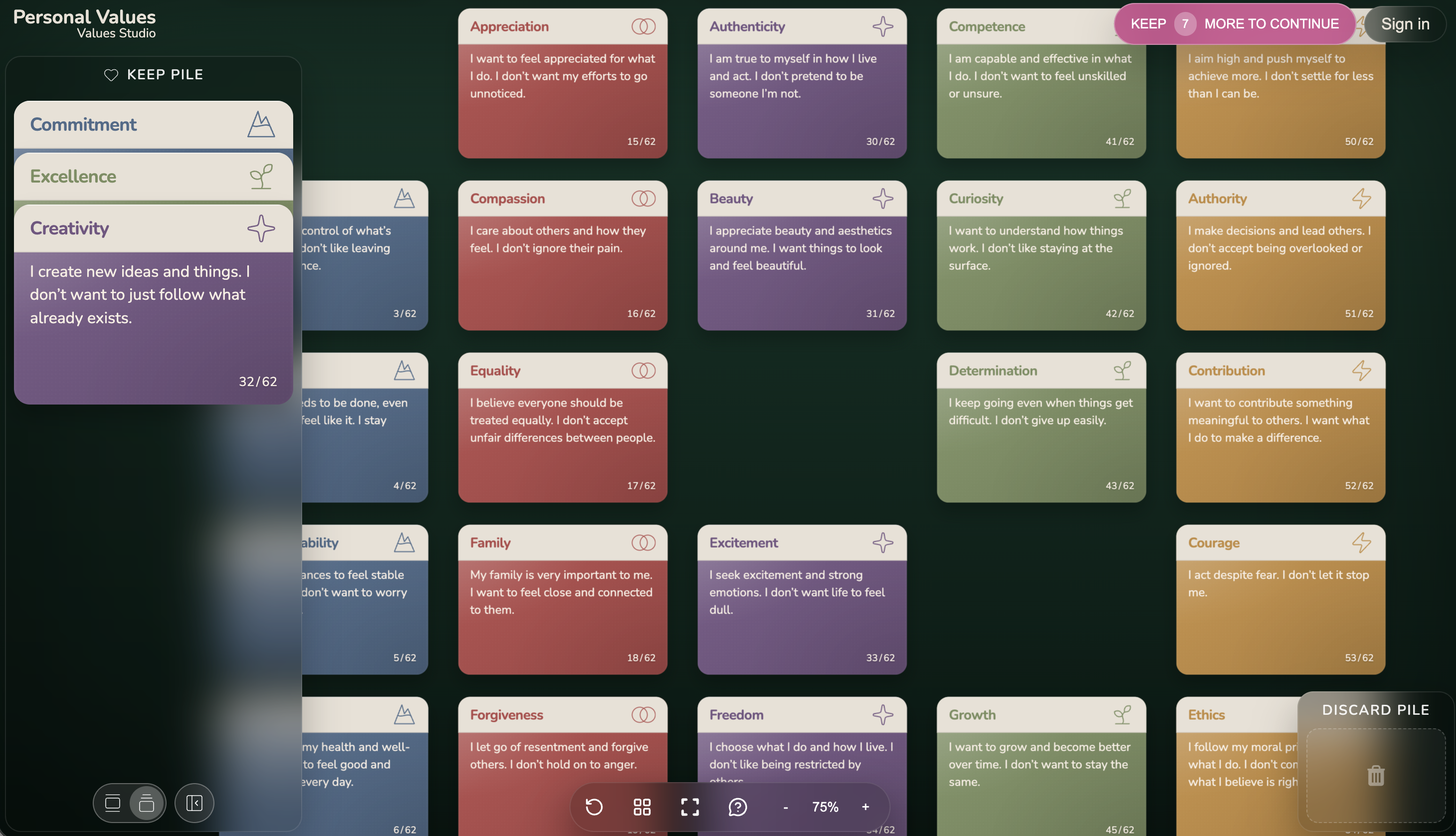
Step 2 - Narrow the keep pile down to ten
Once your keep pile is complete, refine it to a shortlist of ten values. This is where the real thinking begins. Ten is small enough to force choices but large enough to capture what matters. If you have twenty cards you love, ask of each: "If a job gave me everything else but not this, could I still be happy there?" The values that survive that question stay.
Step 3 - Compare them in pairs
With ten values in hand, you move to pairwise comparison: the tool shows you two values at a time and asks which one matters more. Value A or Value B. You keep choosing, pair after pair, and because you can only ever pick one, the tool quietly resolves the ties your gut couldn't. This is the crucial step, because it converts a flat list of "all important" values into a ranked order - and it is your top few values, not your list of ten, that should drive real decisions.
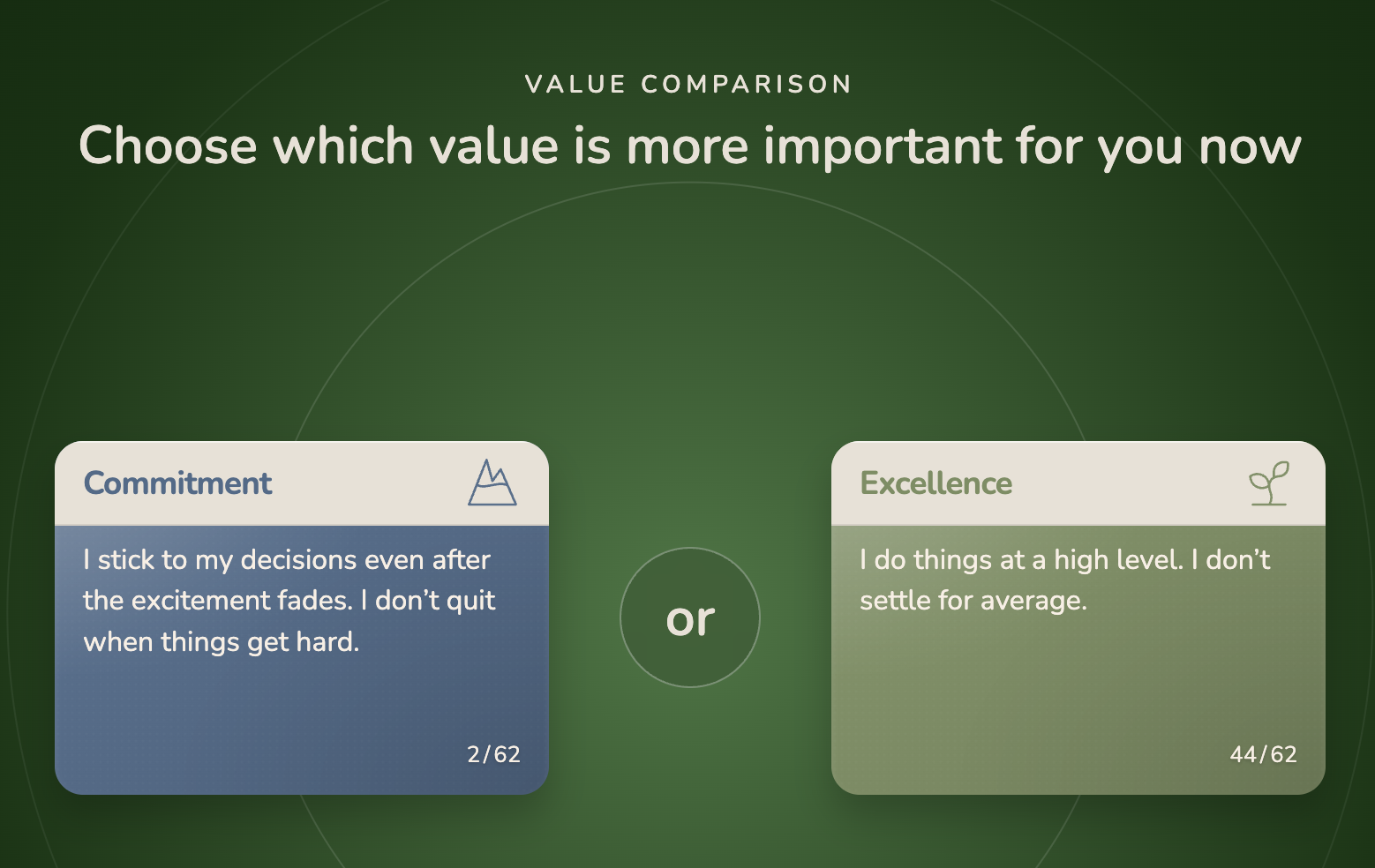
The reason pairwise comparison works so well is that humans are far better at relative judgments ("which of these two?") than absolute ones ("rate this 1-10"). Forcing head-to-head trade-offs - autonomy versus security, income versus impact, balance versus challenge - is what surfaces your true priorities rather than your aspirational ones.
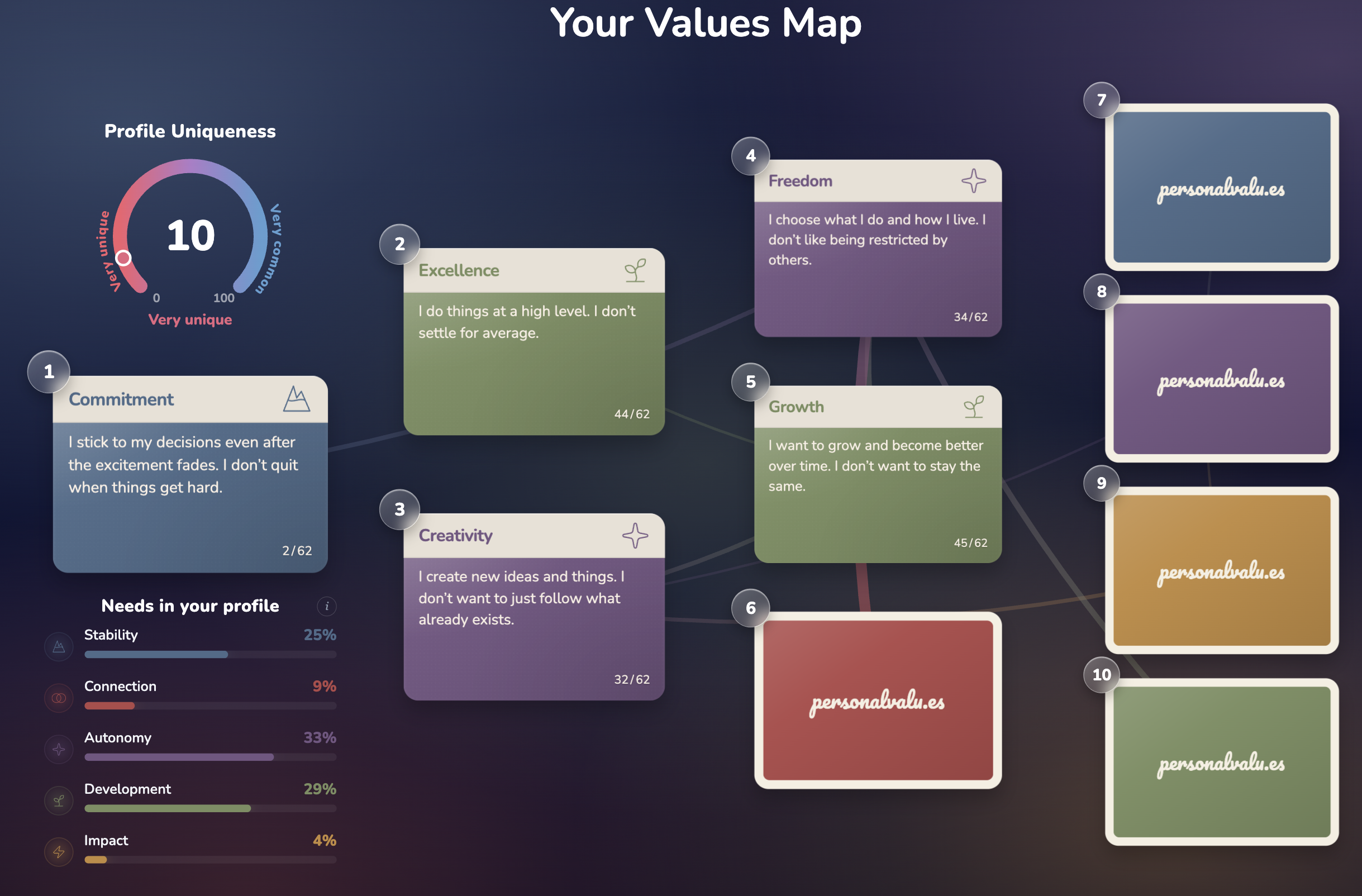
Step 4 - Read your ranked result
At the end you have a ranked list of your top work values, with the two or three at the top being the ones that most define what you need from a job. These are your decision criteria. Everything below is a "nice to have."
What to do with the results
A ranked list of work values is only useful if you act on it. Here is where it pays off:
- Score your current job. Rate your present role from 1 to 5 on each of your top three values. Low scores show you exactly where the friction is coming from - and often the fix is a conversation, a project change, or a boundary, not a resignation.
- Evaluate job offers objectively. Instead of being seduced by salary or title, grade each opportunity against your top values. A role that scores high on your real priorities will almost always outperform a "better on paper" job that violates them.
- Ask sharper interview questions. If autonomy ranks first, ask how decisions get made and how much oversight there is. If growth is top, ask what the last three promotions looked like. Your values tell you what to probe for.
- Diagnose burnout. Chronic dissatisfaction is frequently a values violation in disguise. Naming which value is being starved turns a vague "I hate my job" into a specific, solvable problem.
- Decide when to stay and when to leave. Some misalignments are fixable within your current role. Others are structural and won't change no matter how hard you try. Your ranked values help you tell the difference - and give you the language to justify the decision to yourself and others. (For the internal tug-of-war where two of your own values pull in opposite directions, see what happens when your values conflict.)
Which work values people rank highest
How do your work values compare with everyone else's? The Global Values Research counts how often each of the 62 values makes it into a person's ten, across nearly 2.1 million rankings completed on personalvalu.es since 2020. For the 30 work values above, a clear pattern shows.
Stability and connection come first. The most often ranked work values are trust (37.5% of rankings), peace (36.6%), financial stability (35.5%), respect (30.0%) and freedom (28.0%). Being able to rely on your colleagues and your income matters to more people than anything the work itself offers.
Income stability beats job stability. Financial stability is ranked more than two and a half times as often as job security (13.2%). What people want to be sure of is the money, not necessarily the role that pays it.
Impact values are the rarest. Contribution (5.3%), influence (5.0%) and authority (3.0%) sit near the bottom of all 62 values. If one of them is near the top of your list, it says a lot about the kind of role you need.
How work values differ by age and gender
The age and gender breakdowns (from the rankings since December 2025 whose participants gave them) show work values following life stages:
- Financial stability is the single most ranked value among 18 to 34 year olds, peaking at 40.4% among 25 to 34 year olds.
- Growth is what sets 25 to 34 year olds apart, at 37.6%, against 21.7% for under-18s.
- Meaningful work climbs steadily, from 8.8% among under-18s to 25.6% among 45 to 54 year olds.
- Ambition and success move the other way. Ambition peaks at 14.6% among 18 to 24 year olds and falls to 4.0% at 55 to 64.
Between women and men, the shared ground is large, with financial stability third for both. The gaps are in the details. Men rank discipline (25.0% vs 14.0%), challenge (16.1% vs 9.5%) and success (19.5% vs 13.9%) more often. Women rank meaningful work (20.7% vs 14.8%) and appreciation (16.8% vs 13.9%) more often.
None of this tells you what your work values are. It does tell you whether yours are common or unusual, which is worth knowing when a workplace is built around the common ones.
Why work values matter more than people think
Most people underestimate work values because the cost of ignoring them is invisible in the short term and brutal in the long term. A misaligned job rarely fails on day one - it erodes you slowly, one small compromise at a time, until motivation quietly disappears and you can't quite explain why.
The research is remarkably consistent on this point. Beyond the Kristof-Brown et al. (2005) meta-analysis cited above, an earlier comprehensive review by Meglino and Ravlin (1998) concluded that the congruence between an individual's values and their work environment shapes satisfaction, commitment, and behaviour more powerfully than the values themselves considered in isolation - it is the fit that matters. The foundational work here goes back to Donald Super's Work Values Inventory (1970), which established that people are motivated by distinct, measurable work values and that career satisfaction depends on finding roles that express them. More recent meta-analytic work by Verquer, Beehr, and Wagner (2003) reinforced the pattern, finding that person-organization value fit is reliably associated with higher job satisfaction and lower turnover intentions across dozens of studies.
Put simply: decades of evidence say the same thing. The single most controllable factor in whether you enjoy your work is how well it fits your values - and you cannot optimise for a fit you have never defined. That is why spending twenty minutes naming and ranking your work values is one of the highest-leverage career exercises available, and why it consistently outperforms generic advice about passion, hustle, or "finding your dream job."
Work values also quietly compound over a career. Each job you choose in alignment builds skills, relationships, and reputation in a direction that feels like you. Each misaligned job spends energy pulling you off course. Over ten years, the difference between the two is not a slightly better mood - it is a fundamentally different life.
Frequently asked questions about work values
What are work values?
Work values are the qualities you need from a job or career to feel satisfied, motivated, and engaged - things like autonomy, security, impact, growth, and connection. They describe what work must provide for the hours you spend working to feel worthwhile. Knowing your top work values helps you choose roles that fit you, because research shows the fit between your values and your workplace predicts job satisfaction better than pay or job title.
What is the difference between work values and personal values?
Personal values describe who you are across all of life, while work values are the subset that applies specifically to your job - what employment must provide for you to feel satisfied. They are closely related but not identical. A personal value like family often shows up at work as a work value like flexibility or work-life balance. Institutions codify values in the same spirit but at a group level - the 7 Army Values, for instance, are the US Army's shared standard of conduct, and if you are leaving the service it is worth separating which of them are genuinely yours from which belonged to the uniform.
What are the most common work values?
Common work values include autonomy, security, work-life balance, impact, mastery, growth, financial reward, recognition, variety, collaboration, creativity, structure, leadership, and challenge. In the personalvalu.es framework these cluster into five underlying needs: Stability, Connection, Autonomy, Development, and Impact. Across nearly 2.1 million rankings on personalvalu.es, the work-related values chosen most often are trust, peace, financial stability, respect and freedom, while contribution, influence and authority are among the least chosen (see the research).
How many work values should I have?
Everyone holds many values, but you can only act on a few. A good process narrows a long list down to a shortlist of about ten, then ranks them so your top two or three stand out. Those top values are your real decision criteria, and the rest are "nice to have."
Can my work values change over time?
Yes, and this mirrors how core values themselves can change over time. Work values shift with life circumstances. New parents often elevate flexibility and security. Someone who is financially comfortable may move impact or mastery to the top. A person recovering from burnout may suddenly prioritise peace and autonomy. The research data shows the same drift across age groups. Growth and financial stability peak in people's twenties and early thirties, while meaningful work is ranked nearly three times as often by 45 to 54 year olds as by under-18s. Reassessing your work values every few years keeps your career aligned with who you actually are now.
What is a work values assessment?
A work values assessment is a structured exercise that helps you identify and rank what you need from a job to feel satisfied. Rather than asking you to rate values one by one, the most effective format sorts a deck of value cards into a keep pile, narrows it to about ten, then uses pairwise comparison to force trade-offs and produce a ranked order. The Personal Values Studio runs this kind of work values assessment in about twenty minutes and hands you a ranked list of your top priorities.
How do I find my work values?
The most reliable method is card sorting followed by pairwise comparison. Sort a deck of value cards into a keep pile, narrow it to about ten, then compare them two at a time to force a ranking. Tools like the Personal Values Studio are built exactly for this and produce a ranked list in about twenty minutes.
Are work values the same as career interests?
No. Interests are the topics you enjoy (design, medicine, finance), whereas work values are the conditions you need to feel fulfilled regardless of topic. You can be interested in a field that violates your values, or uninterested in one that satisfies them - which is why values, not interests, best predict long-term job satisfaction.
Why do my work values matter for job satisfaction?
Because research consistently shows that the fit between your values and your workplace predicts satisfaction, commitment, and how long you stay - often more than pay or prestige. When work honours your top values it feels meaningful. When it violates them, even a good job becomes draining. Defining your values is the first step to choosing work you can actually enjoy.