Online values card sort
Explore 62 personal values, compare the ones you keep, and see them ranked. Free, in about ten minutes.
Start the card sort- Free
- No account required
- 2M+ completed assessments
- Refined through real-world data
Trusted by people exploring their values since 2018
Used by people at
Microsoft, Electronic Arts, BCG, Google, Capital One, Bayer, Oracle, Salesforce, Chevron, Cisco, HP, Volvo, BMW, Canva, Accor
The method
What is a values card sort?
A values card sort is a reflection exercise that helps you identify and prioritize what matters most to you. Traditionally, each value is written on a separate card, and you sort the cards according to how important each value is to you. Today, the same values sort activity can also be done online.
Versions of this method have been used in coaching, counselling and personal development for decades. One well-known example is the Personal Values Card Sort developed by William R. Miller and colleagues.
The challenge is that almost every value sounds good, so it’s easy to end up with a long list of things you consider important. The real insight comes from comparing values and deciding which ones take priority when they compete. Choosing values you like is easy. Deciding which one gives way when two pull you in different directions reveals more about what you actually prioritize.
Read all 62 values with their meaningsHow it works
How the online card sort works
Explore 62 value cards, each with its own meaning. Keep the ones that feel like you, compare them two at a time, and discover your personal ranking.
For example, Family, Honesty, Inner harmony kept, and Wealth, Tradition, Fame passed over.
01Keep the cards that fit
Go through 62 value cards, each with what it means, and keep the ones that feel like you. Around ten is a good number to aim for.
- 02
Compare them in pairs
The values you selected are compared two at a time. Each time, choose the one that matters more to you. Every choice involves a trade‑off, just like the decisions you face in real life.
- FamilyMy family is very important to me. I want to feel close and connected to them.18/62HonestyI tell the truth and act honestly. I don’t hide or twist things.27/62Inner harmonyI feel calm and at peace within myself. I don’t want inner tension or conflict.7/62CuriosityI want to understand how things work. I don’t like staying at the surface.42/62CreativityI create new ideas and things. I don’t want to just follow what already exists.32/6203
See your values ranked
See your values ranked by importance, from your highest priority to the rest of your top ten, along with the needs associated with each value.
Your choices determine the ranking.
Your ranking reflects the priorities you establish through comparing values. The result is a starting point for understanding what matters most to you.
Why the order matters
Liking a value is not the same as putting it first
A list of values you care about is a starting point. What matters is knowing which comes first when two values compete. Most people want both freedom and security, until a decision forces them to choose.
There is no right answer. The card sort helps you compare values one pair at a time and build a ranking based on your choices.
What happens when your values conflictKept often is not the same as ranked high
Freedom appears in more top-ten lists than Security. But when Security makes the list, it tends to rank higher. These figures show what people chose, not what you should choose.
From 2,099,004 completed assessments, July 2020 to September 2026.
More than a card sort
Your values, beyond the cards
A values card sort helps you discover what matters most to you. Personalvalu.es gives you more ways to explore your results, share your values, and understand how your priorities fit into a broader picture.
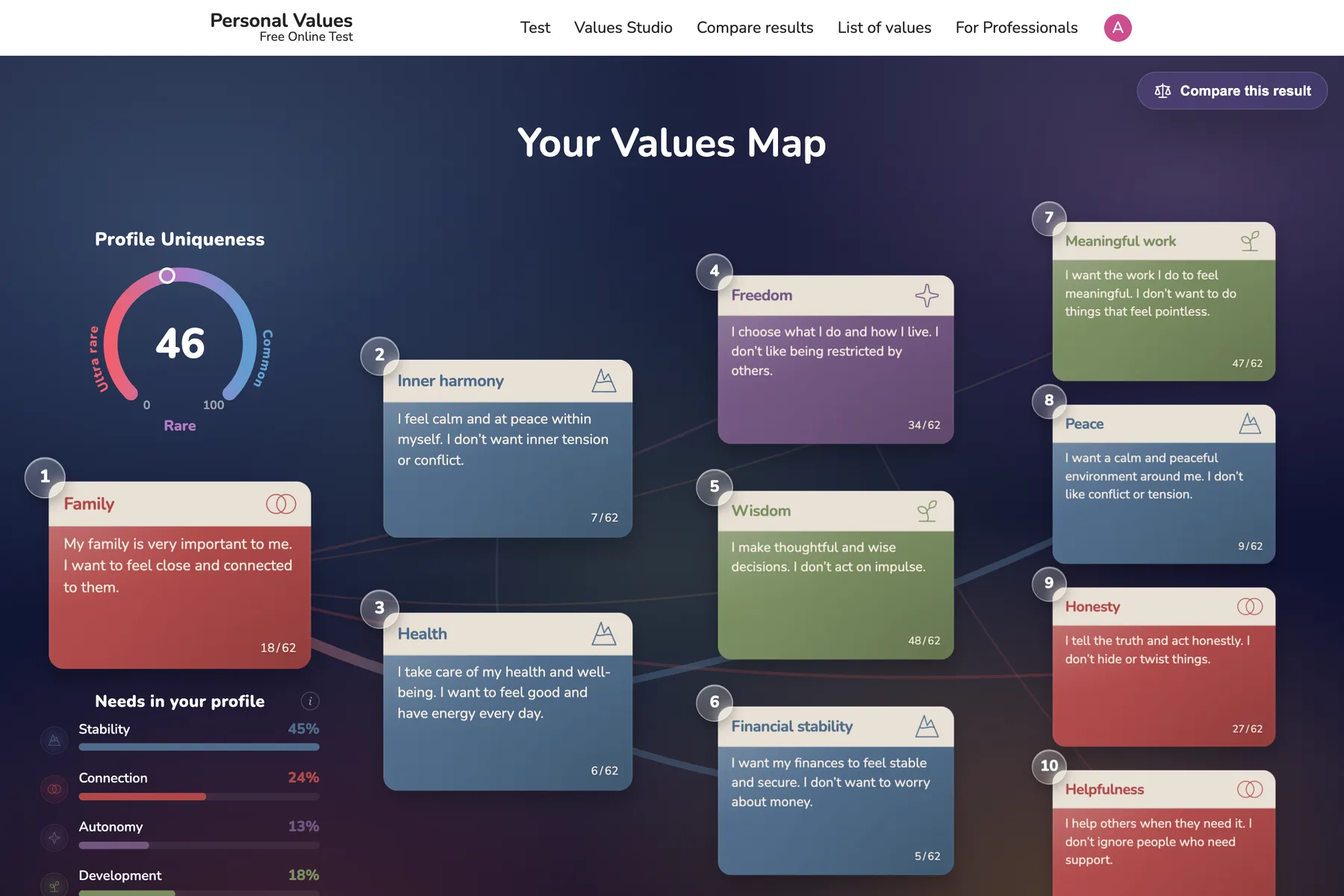
Save your results
Sign in and your ranked values stay in your account. Come back to them whenever you like, or sort again later and see how your priorities change.
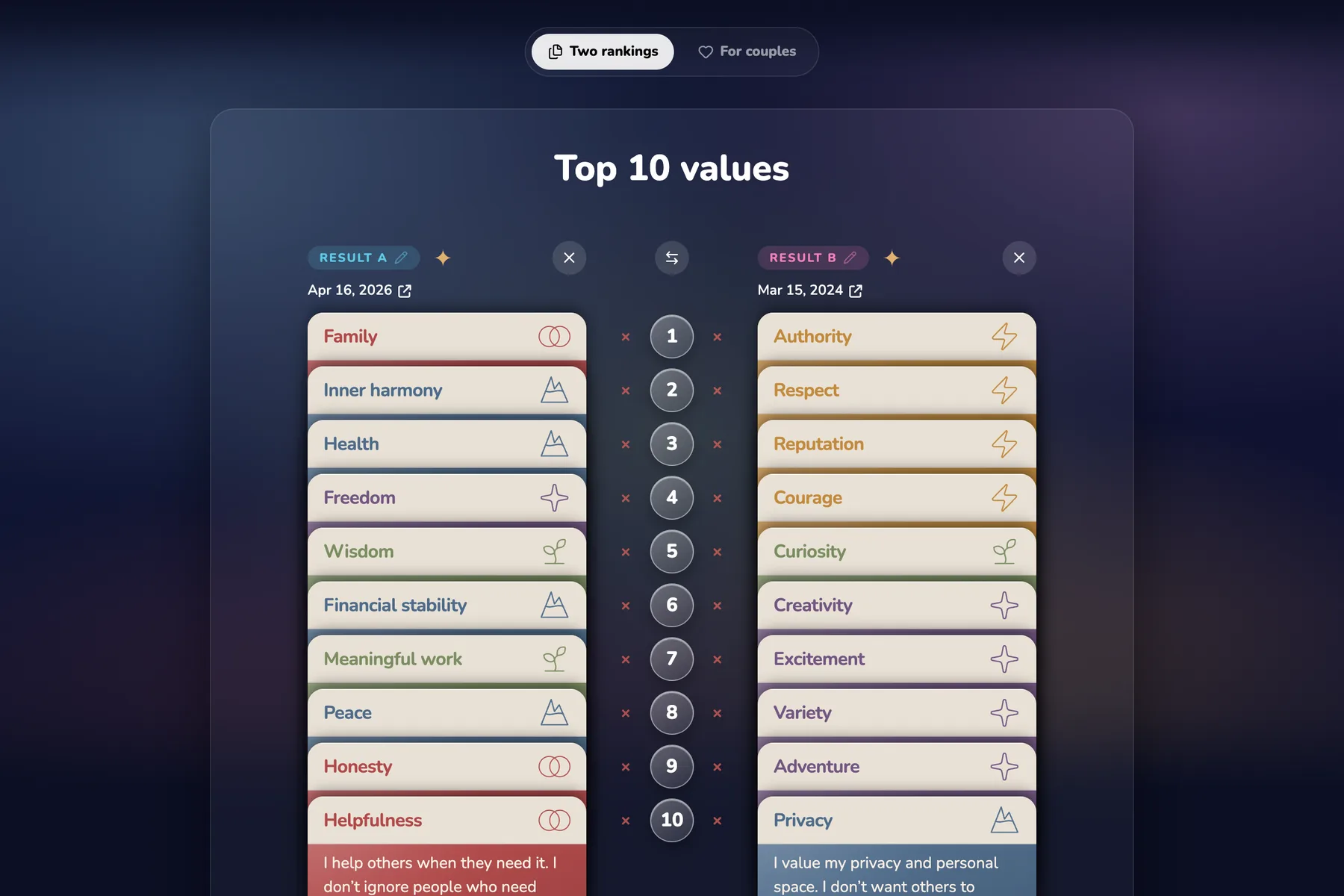
Share and compare your values
Every result has its own link. Send it to a coach, a partner, or someone you want to understand better, and if they sort their values too, compare your rankings side by side.
Compare two resultsMost often in a top ten
- Health46.6%
- Family41.5%
- Trust37.5%
From 2,099,004 completed assessments
Explore the bigger picture
Explore aggregated data from completed assessments to see which values make it into a top ten most often and how high they tend to rank.
Explore the research- Health
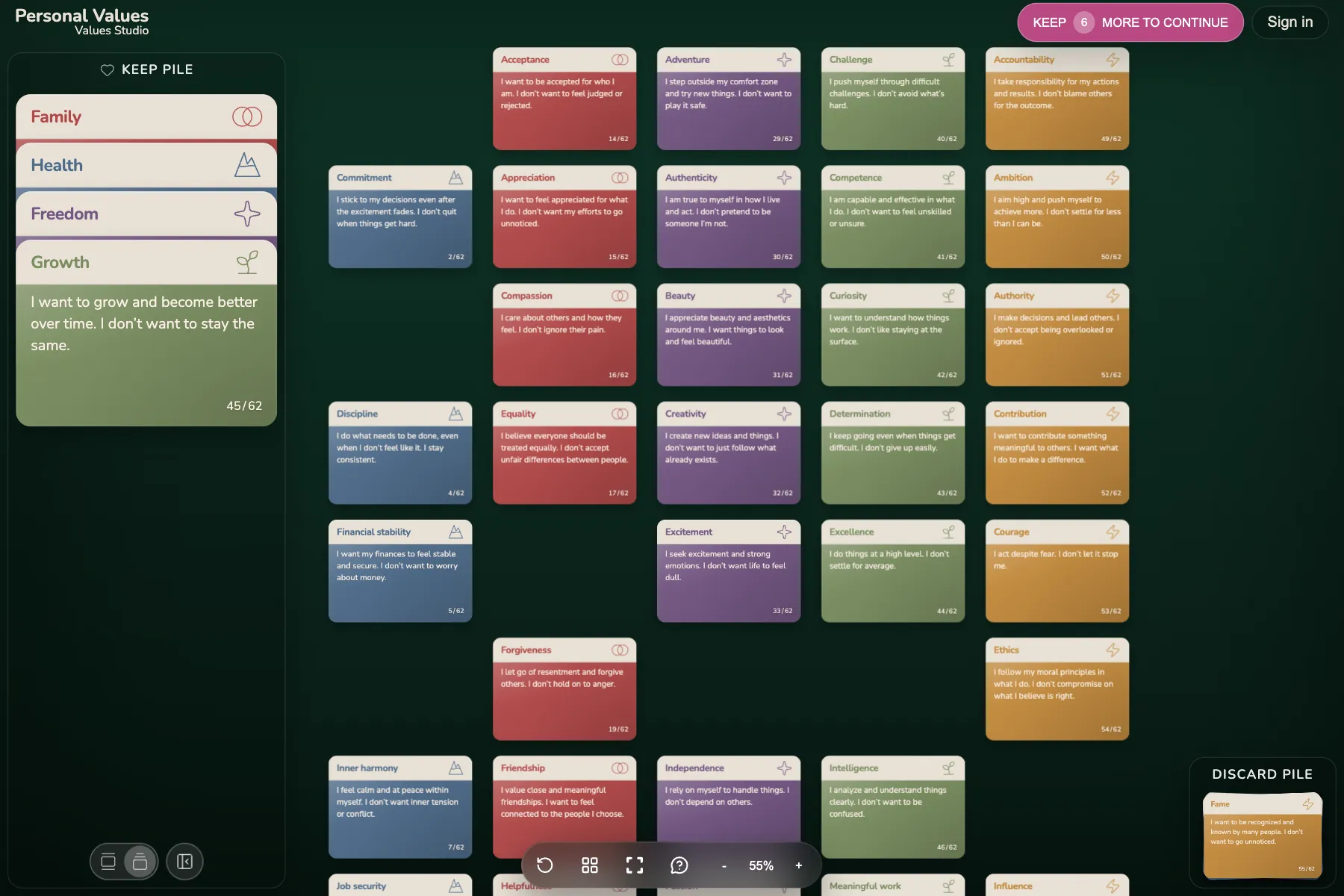
Go beyond your top ten
On a laptop or desktop, Values Studio puts all 62 value cards on one table, each with what it means. Move them, group them, and keep or set aside as many as you like.
Open Values Studio
For coaches and facilitators
Use it with clients and groups
Invite clients to complete a values card sort before your session. They explore 62 values, compare their priorities, and arrive with a personal ranking you can discuss together.
- 01
Send an invitation
Add your client's name and send a link. No installation required.
- 02
They discover their priorities
Clients select the values that matter to them and compare them in pairs to build their ranking.
- 03
Start with their results
Review their ranking before the session and use it to guide your conversation.
Running a workshop?
Invite the whole group with one link. Collect participants' rankings in one place and use them to start a shared discussion.
A conversation starter.The ranking is a starting point for reflection. You and your client decide together what it means.
Questions
Common questions about the card sort
A values card sort is a reflection exercise in which each personal value is written on its own card and you sort the cards by how much they matter to you. Versions differ: many have you sort the deck into piles of importance, and some end by putting the most important few in order. The best known is the Personal Values Card Sort by William R. Miller and colleagues, often used in motivational interviewing.
You go through 62 value cards, each with a short description, and keep the ones that feel like you. The cards you kept then come back two at a time, and each time you pick the one that matters more. Those choices put your values in order, and you see them ranked, up to a top ten, from the one that matters most.
Yes. The card sort is free and needs no account, and so is your result: your top five values in order, with the needs behind them, which you can share with a link. Seeing all ten, the connections across the whole ranking and the complete PDF report is an optional one-time purchase.
62. The list was built to cover the range of personal values without duplicates or near-synonyms, and every card says what its value means. Everyone sorts the same fixed list, which is what lets rankings be compared between people and over time.
See the 62 core valuesThe values sort exercise takes about 10 minutes if you keep around ten cards. Every card you keep beyond that adds comparisons, and the sort takes longer.
Compare them directly, two at a time, and ask which one you would hold on to if you could keep only one. Rated one by one, most values can score high; a choice between two makes the trade-off visible. The first three to five in the order you end up with are the ones to check a hard decision against.
Yes. Send a client an invitation and they do the card sort on their own device; their ranking and the needs behind it are on your dashboard before you meet. For a workshop, a group invitation is one link for the whole room. Treat the result as a starting point for the conversation rather than a clinical measure.
Invitations for professionalsThe names overlap. A card sort is a hands-on method: you handle a deck of values and sort it yourself. A personal values assessment is the wider term for any structured way of finding out what matters to you, including questionnaires that score your answers. The exercise on Personalvalu.es is both: it starts as a card sort, and comparing the cards in pairs turns it into a ranking.
About the personal values assessmentCan I print the cards?
There is no deck to print, but the full list of 62 values with what each one means is available as a PDF. It works as a printed list or for cutting into your own cards.
Download the list of valuesDiscover what matters most to you
Explore your values, compare your priorities, and leave with your own personal hierarchy. Free, with no account needed.
Start the card sort